The Vograat
The Man Who LaughsThe Vograat is the Dutch ship that receives Gwynplaine and Homo on the Thames and carries them away from London. Identified by the white lettering Vograat, Rotterdam on its black hull, it becomes the means of their escape and the setting for Gwynplaine’s desperate hope that life can begin again with Dea.
Appearance and Construction
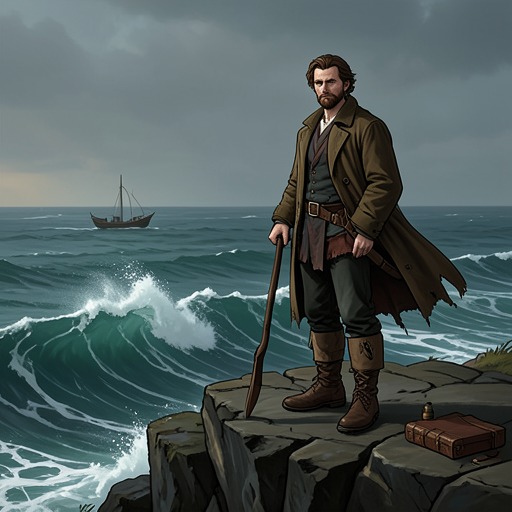
The ship lies at a wharf on piles, its main deck almost level with the platform. It is a massive, black-painted vessel, large enough to loom in the night; a faint light near the prow is its only visible sign of life. The name and home port, painted in white on the hull, make the ship legible even in the darkness.
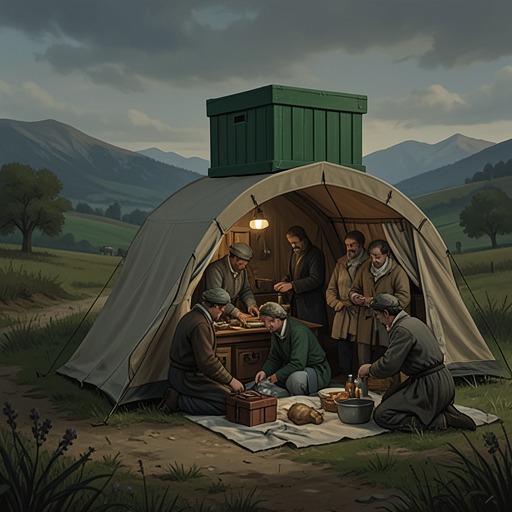
The Vograat has the Dutch design described in the novel as Japanese in build: two decks, one forward and one aft, with an open cargo hold between them. A ladder leads down into the hold, where a passage runs among the bales and cases. Cabins beneath the decks open onto this space and receive light through glazed portholes. The foremast is called Paul and the mainmast Peter; a gangway bridges the hold between the decks. In heavy weather, hinged sections of the gangway can be lowered to roof the hold, closing it against the sea. The vessel’s heavy construction includes a beam for a tiller, while its decks lack bulwarks.
Boarding and Departure
When Homo has led Gwynplaine to the river, the wolf proceeds along the wharf and confirms that Gwynplaine is there before bounding onto the vessel. Gwynplaine and Homo follow. The deck is clear and still: the cargo is stowed, the passengers are presumed asleep below, and the crew is likely eating while waiting for the sailing hour. The absence of activity makes the ship feel less like a busy harbor scene than a quiet passage already prepared for them.
The skipper comes aft, releases the hawser, and works the tiller. While the Vograat remains in the river, the other sailors are not needed. The ship drifts into the current and is carried onward by the ebb; the Thames is calm, and London recedes behind it into mist. The departure is not presented as a triumphant homecoming but as a narrow opening away from the city and its ordeals.
Gwynplaine, Homo, and Dea Aboard
Homo’s conduct marks the change from search to companionship: on the wharf he had hurried forward, but once aboard he slows to a discreet walk and crosses the gangway ahead of Gwynplaine. On deck, his tail moves softly against the planks. The animal’s quiet presence gives Gwynplaine a surviving companion at the moment when he believes that only he and Homo remain to care for Dea.
Gwynplaine addresses Dea as she lies aboard, taking a small movement of her arm as a possible sign that she will wake. He reads her pallor, flush, and apparent color in rapid succession as reasons to hope that she is merely weak or feverish and will recover. His speech turns from watching her condition to imagining work and a new life for the two companions who remain. The ship moves while he is speaking, making his hope coincide with the physical departure from London. The Vograat thus carries not only its passengers but also the fragile prospect Gwynplaine projects onto their passage; the calm river and his confidence in a fine night stand against the uncertainty of Dea’s condition and what awaits them at sea.